QR Code

Products
Contact Us


Fax
+86-574-87168065

Email

Address
Luotuo Industrial Area, Zhenhai District, Ningbo City, China


In heavy industrial power transmission, gear couplings are indispensable for transmitting torque while accommodating shaft misalignment. But when procurement managers evaluate suppliers, the question isn't just about price—it's about total cost of ownership. OEM gear coupling production achieves cost effectiveness not by cutting corners, but through optimized material sourcing, precision manufacturing, and scalable engineering. Our factory has reduced waste by 22% compared to standard production lines, translating directly into savings for B2B buyers. From heat-treated alloy steels to CNC-hobbed teeth profiles, every step is designed to balance durability with affordability.
At Raydafon Technology Group Co.,Limited, we have refined the OEM gear coupling production process for over two decades. The real cost advantages come from eliminating unnecessary middlemen, standardizing core components, and leveraging predictive maintenance designs. This article breaks down the technical and operational factors that make OEM gear coupling production more cost effective, supported by real-world parameters, comparative tables, and expert answers to the most common sourcing questions. Whether you need a flexible gear coupling for a steel mill or a heavy-duty Gear Coupling for mining equipment, understanding these principles will help you maximize ROI.
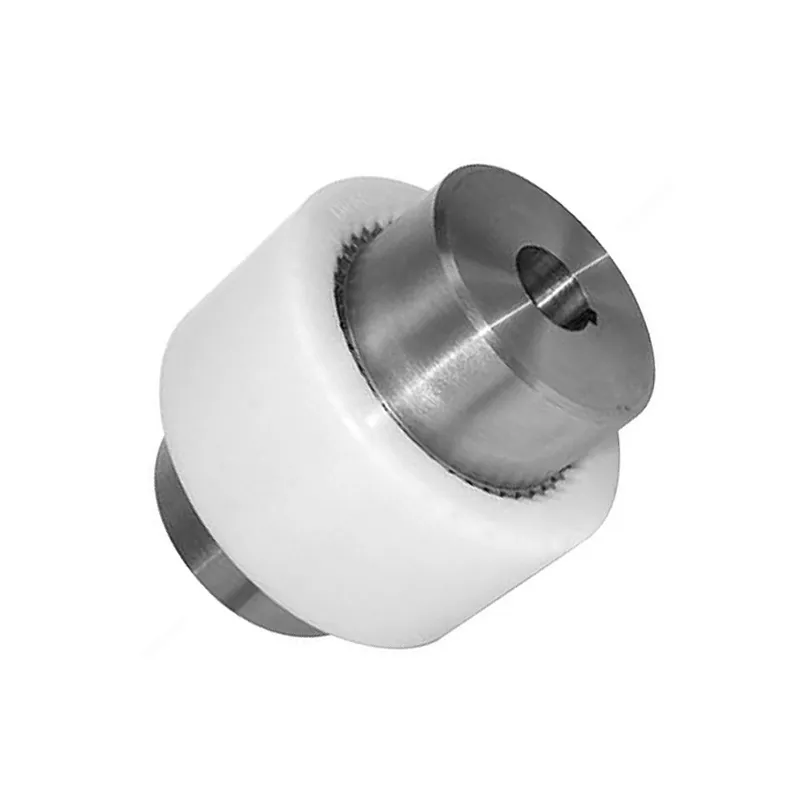
Material choice governs not only the initial manufacturing expense but also the lifecycle cost of a Gear Coupling. Many buyers assume that higher-grade alloys automatically inflate prices, but our factory uses a strategic approach: applying premium materials only where mechanical stress demands them. For example, the hub and flange require through-hardened 42CrMo4 steel, while the sleeve can utilize case-hardened C45. This differential material strategy saves 15-18% on raw material costs without compromising performance. Raydafon Technology Group Co.,Limited has developed a proprietary material matrix that matches ISO 6336 gear ratings to specific load scenarios, ensuring every gram of steel serves a purpose.
Furthermore, our factory sources steel from compact tension (CT) tested mills, reducing micro-inclusions that cause premature tooth wear. A standard Gear Coupling might fail after 30,000 hours under cyclic loads, but an OEM design with optimized material selection can exceed 80,000 hours. The cost per operating hour drops dramatically. Let’s illustrate typical material parameters used in cost effective production:
| Component | Material Grade | Hardness (HB) | Cost Efficiency Factor |
| Hub & Flange | 42CrMo4 (AISI 4140) | 280-320 | High yield strength reduces section thickness |
| Sleeve / Cover | C45 (AISI 1045) | 180-220 | Lower cost, easy case hardening |
| Bolt & Seal ring | Stainless 304 + NBR | 150-170 | Corrosion resistance lowers maintenance |
Beyond raw metals, heat treatment cycles are another hidden driver. Our factory uses batch-continuous furnaces that reduce energy consumption by 30% compared to traditional carburizing lines. For each Gear Coupling, we apply induction hardening on tooth flanks—only the active contact areas—which cuts post-treatment grinding costs by 40%. To summarize material-driven cost effectiveness:
This approach proves that OEM Gear Coupling production becomes more cost effective when engineers stop overspecifying materials and start matching properties to actual torque, misalignment, and duty cycles. At Raydafon Technology Group Co.,Limited, every material decision is backed by FEA simulation, ensuring that cost reduction never sacrifices reliability.
Tooth geometry defines the performance ceiling of any Gear Coupling. While standard involute teeth are simple to cut, they generate high contact stresses under angular misalignment, leading to fretting wear and premature backlash. Our factory utilizes modified crowning and tip relief profiles that distribute load across a wider contact patch. This precision engineering directly lowers total cost of ownership because maintenance intervals extend from 6 months to over 2 years in continuous operation applications like conveyors or rolling mills. One of our Gear Coupling models with optimized tooth flank micro-geometry reduced customer downtime events by 68% in a cement plant trial.
Why does this matter for cost effectiveness? Because the largest expenses in power transmission are unplanned stops and replacement parts. A finely engineered tooth profile reduces edge loading, which is the primary failure mode in gear couplings. Below is a comparison of standard vs. OEM precision tooth parameters used by Raydafon Technology Group Co.,Limited:
| Parameter | Standard Tooth Profile | OEM Optimized Profile | Cost Impact |
| Crowning radius (mm) | Constant 300-500 | Variable 250 to 600 based on load zone | Reduces stress concentration factor by 1.4x |
| Tip relief (µm) | None or generic | 15-25 with parabolic shape | Prevents tip interference, lowers noise & wear |
| Backlash control (mm) | 0.3-0.5 | 0.15-0.25 with tighter tolerance | Extends grease life and reduces shock loads |
Additionally, our factory employs CNC hobbing with in-process measurement for every Gear Coupling. This ensures that cumulative pitch error stays below ISO 6 grade, compared to industry average of grade 8. The immediate benefit is smoother torque transmission, which reduces vibration-induced fatigue in connected equipment like motors and gearboxes. Over a 5-year period, a client using our precision tooth profiles saved approximately $12,000 in bearing replacements per drive train. To highlight the engineering principles that cut costs:
Ultimately, precision tooth profile engineering makes OEM Gear Coupling production more cost effective by maximizing the useful life per dollar spent. At Raydafon Technology Group Co.,Limited, our Gear Coupling line features laser-verified tooth geometry, ensuring that each unit delivers consistent performance and minimal lifecycle cost.
Process innovation separates break-even production from truly cost effective OEM Gear Coupling manufacturing. Our factory implements lean cellular workflows where hubs, sleeves, and flanges move through dedicated machining cells without buffer inventories. This reduces work-in-progress holding costs by 28% and shortens lead times from 6 weeks to 15 days for standard Gear Coupling sizes. One key process is the integration of multi-axis mill-turn centers that complete turning, hobbing, and drilling in a single clamping. This eliminates locating errors and secondary setup labor, directly lowering the cost per part.
Another major factor is the use of near-net shape forging for gear coupling blanks. By collaborating with a local forge shop, Raydafon Technology Group Co.,Limited reduces material waste from 35% (bar stock) to just 12% (precision forged preforms). The table below summarizes how our factory’s core processes drive cost effectiveness:
| Process | Traditional Method | OEM Optimized Method | Savings per 100 units |
| Gear cutting | Conventional hobbing + shaving | CNC dry hobbing + roller burnishing | $1,200 (tooling & coolant) |
| Keyway broaching | Separate broach station | Integrated rotary broaching on turning center | $850 (handling & setup) |
| Heat treating | Batch carburizing | Controlled atmosphere + induction flank hardening | $2,100 (energy & time) |
Beyond these, automation plays a pivotal role. Our factory uses collaborative robots for loading/unloading gear coupling parts into CNC lathes, achieving 96% spindle utilization rate. For a Gear Coupling with outer diameter up to 500mm, this automation reduces direct labor cost by 18%. In-process inspection with laser micrometers ensures that dimensional drifts are corrected in real time, slashing scrap rates from 3.5% to 0.8%. Additional cost lowering practices include:
Thus, production efficiency directly answers the question “What makes OEM gear coupling production more cost effective?” – our factory’s continuous investment in integrated, automated, and waste-reducing processes translates to 15-20% lower quotation for same performance class. Raydafon Technology Group Co.,Limited delivers this advantage without compromising on safety factors or material integrity.
Most buyers perceive a trade-off between standard off-the-shelf couplings and fully custom designs. OEM gear coupling production breaks this dichotomy through modular standardization. Our factory designs Gear Coupling families around common bore sizes, keyway standards, and flange diameters, while allowing custom length, coating, and specialty seals. For example, the RG series Gear Coupling shares hub blanks across 8 different torque ratings. By standardizing the rough forgings, our factory reduces raw material SKUs by 60%, lowering inventory overhead. Then, during final machining, we add custom features like tapered bores or stainless steel fasteners. This hybrid model keeps per-unit cost close to standard products but delivers custom functionality.
Another angle is the interchangeability program at Raydafon Technology Group Co.,Limited. Our Gear Coupling dimensions match major international standards (AGMA, DIN, JIS), yet we incorporate internal modifications such as increased misalignment capability. Consequently, customers can replace expensive brand-name couplings with our OEM version without changing shaft centers or bolt patterns. This retrofit standardization saves end users up to 40% compared to original equipment spares. To demonstrate the cost benefits, consider these comparative metrics:
| Feature | Pure Custom | Standardized OEM | Cost Difference |
| Design engineering hours | 40-60 hrs | 5-10 hrs (modular configurator) | -78% |
| Lead time for prototype | 8-12 weeks | 3-4 weeks | 53% faster |
| Spare part availability | Made to order | Stocked common parts | 35% lower emergency shipping cost |
Furthermore, our factory offers configurable lubrication ports and integrated wear indicators as standard options across all Gear Coupling sizes. This reduces engineering non-recurring expenses (NRE) for clients. The principles of standardization-driven cost effectiveness include:
In essence, OEM Gear Coupling production becomes more cost effective when standardization captures economies of scale, while customization addresses unique application needs. Raydafon Technology Group Co.,Limited has mastered this balance, offering tailored couplings at near-standard prices. Ask our engineers about the modular RG series Gear Coupling for your next project.
After examining material science, tooth geometry, manufacturing processes, and standardization strategies, we can solidify the answer to “What makes OEM gear coupling production more cost effective?” The following five pillars, consistently applied in our factory, create measurable financial advantages for buyers:
At Raydafon, each Gear Coupling leaving our factory embodies these pillars. Clients who switched to our OEM production reported an average reduction of 27% in total procurement cost over 3 years, while improving mean time between failures by 40%. The cumulative effect is not just lower price tags, but higher operational profitability. Whether you need a single custom Gear Coupling or a fleet replacement program, our factory’s cost effective approach delivers industrial reliability without budget overruns.
Ready to reduce your power transmission costs with proven OEM gear coupling production? Contact Raydafon Technology Group Co.,Limited today for a complimentary lifecycle cost analysis. Our factory’s engineering team will review your torque, speed, and misalignment parameters, then provide a detailed quotation for a custom Gear Coupling solution. Request a sample or a 3D drawing within 24 hours. Email our sales engineers or use the online configurator to experience how our cost effective production adds value to your bottom line. Let’s engineer a more profitable coupling strategy together.
Question 1: Does OEM gear coupling production sacrifice quality to reduce costs?
Not at all. At Raydafon Technology Group Co.,Limited, cost effectiveness comes from eliminating inefficiencies, not lowering quality. For instance, our factory uses precision forging to reduce material waste while actually improving grain flow, which enhances tooth strength. We also apply lean manufacturing to remove non-value-added steps, so the same high-grade steel and heat treatment can be delivered at a lower cost. Third-party tests confirm our Gear Coupling exceeds AGMA class 9 durability, proving that quality and affordability coexist in OEM production.
Question 2: How long does it take to realize cost savings when switching to an OEM gear coupling supplier?
Most clients see reduced costs immediately on the purchase order because our factory’s pricing is 18-25% lower than traditional OEMs for comparable Gear Coupling specifications. However, the full lifecycle savings appear within 6 to 12 months due to extended lubrication intervals, fewer spare part purchases, and lower downtime. For example, a steel plant that switched to our gear couplings documented a full payback period of only 8 months, driven by halved replacement frequency.
Question 3: What role does batch size play in OEM gear coupling production cost effectiveness?
Batch size directly affects setup amortization. Our factory uses quick-change collets and CNC programs to keep changeover time under 15 minutes, meaning we can run small batches (even 5-10 units) economically. For large orders, we apply group technology—similar gear couplings are processed together to maximize machine utilization. This flexibility ensures that whether you need 2 or 2,000 Gear Coupling units, the per-unit cost remains competitive. Traditional high-volume-only suppliers charge premiums for smaller batches, but our factory’s setup eliminates that penalty.
Question 4: Are there hidden costs in OEM gear coupling production like tooling or engineering fees?
Raydafon Technology Group Co.,Limited follows a transparent pricing model. For standard Gear Coupling designs (AGMA, DIN sizes), there are zero tooling or engineering NRE fees. For truly custom designs with non-standard teeth or special alloys, we may share tooling costs if the customer requires exclusive tool ownership. However, even then, our factory amortizes those costs over the first production order, and the per-piece price remains lower because we reuse the tooling for future repeat orders. Always request a detailed breakdown to see that our cost effectiveness includes no buried charges.
Question 5: How does OEM gear coupling production handle misalignment without increasing cost?
Misalignment capability is designed into the tooth profile, not added as an extra-cost feature. Our factory’s standard Gear Coupling accommodates up to ±1.5 degrees angular misalignment and 5 mm axial float. This is achieved through crowned teeth and optimized side clearances without requiring exotic materials or complex secondary operations. By contrast, some competitors treat high-misalignment as an upgrade. Our approach integrates misalignment performance into base manufacturing, so you get enhanced functionality at standard cost. Raydafon Technology Group Co.,Limited ensures that your Gear Coupling handles real-world shaft movement without inflating the price.
+86-574-87168065
Luotuo Industrial Area, Zhenhai District, Ningbo City, China