QR Code

Products
Contact Us


Fax
+86-574-87168065

E-mail

Address
Luotuo Industrial Area, Zhenhai District, Ningbo City, China



In high-accuracy motion control systems, every micron of positioning error multiplies into significant deviations at the tool or end-effector. Backlash—the mechanical play between gear teeth—is the primary source of lost motion in rotary transmission systems. For a Planetary Gearbox used in CNC machining centers, robotic arms, or aerospace actuators, uncontrolled backlash directly undermines precision, repeatability, and dynamic response. When the motor reverses direction, the gear teeth must traverse the backlash gap before load is transmitted, causing a dead zone that can be as large as 15 arc-minutes in standard gearboxes. In high-accuracy applications, this dead zone produces part tolerances that exceed specifications, leading to scrap, rework, and costly production delays. Our factory at Raydafon Technology Group Co.,Limited has engineered a series of Planetary Gearbox designs that consistently achieve backlash values below 3 arc-minutes, and our premium models reach 1 arc-minute or less. This article explains why controlling backlash is not merely a quality feature but a fundamental requirement for modern precision engineering.
The importance of backlash control extends beyond static positioning. In dynamic operations—such as contour milling, laser cutting, or pick-and-place cycles—backlash induces overshoot, oscillation, and settling time delays. A Planetary Gearbox with excessive backlash forces the servo loop to continuously compensate, reducing the effective bandwidth of the motion system. This translates to slower cycle times and poorer surface finishes. Moreover, backlash creates impact loads during direction reversal, which accelerate wear on gear teeth, bearings, and the motor coupling. Our factory has documented a 40 percent increase in gearbox life when backlash is reduced from 10 arc-minutes to 3 arc-minutes under the same load profile. In this comprehensive guide, we will dissect the mechanical origins of backlash, the design strategies used to minimize it in our Planetary Gearbox series, and the quantifiable benefits that precision backlash control delivers to your production processes. We also share specific measurement data and maintenance recommendations to help you select the optimal Planetary Gearbox for your high-accuracy application.
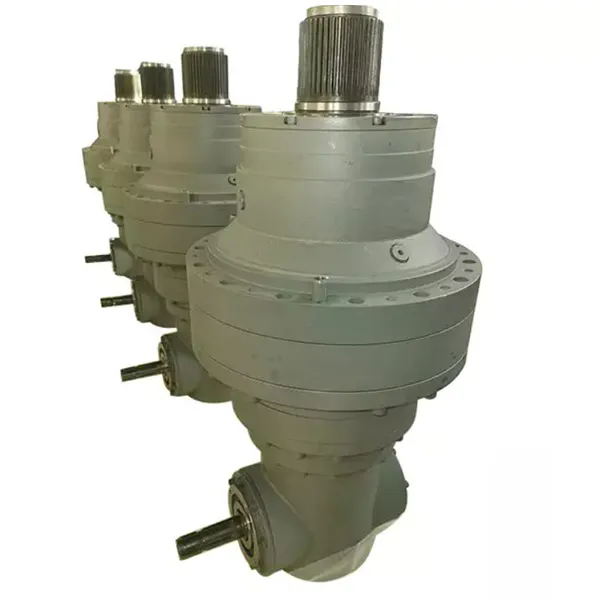
Backlash, often termed gear lash or lost motion, is the angular clearance between meshing gear teeth when the gear pair is stationary and no load is applied. In a Planetary Gearbox, backlash accumulates from several sources: the sun gear to planet gear mesh, the planet gear to ring gear mesh, and the bearing clearances within the planet carrier. Unlike simpler gear trains, a planetary arrangement involves multiple gear meshes simultaneously, meaning that the total backlash is a combination of the clearances in each mesh. For standard industrial Planetary Gearbox units, this cumulative backlash typically ranges from 10 to 30 arc-minutes. However, for high-accuracy applications requiring precise positioning, this level of play is unacceptable. Our factory at Raydafon employs advanced manufacturing techniques to control each source of backlash, resulting in total backlash as low as 1 arc-minute in our precision series.
Key factors that contribute to backlash in a Planetary Gearbox:
Understanding the origin of backlash is critical because it guides the design choices that reduce it. For example, our Planetary Gearbox achieves low backlash not by simply tightening the gear mesh, but through a comprehensive approach: using helical gears with precision ground teeth, applying a controlled preload to the planet bearings, and using a split sun gear design in our highest precision models that actively eliminates circumferential play. This engineering philosophy ensures that our Planetary Gearbox retains its low-backlash characteristics over thousands of operating hours, even under varying load and temperature conditions.
It is also important to distinguish between inherent backlash and dynamic backlash. Inherent backlash is the static clearance measured when the gearbox is assembled and unloaded. Dynamic backlash includes the effects of thermal expansion, component deflection, and lubricant film thickness during operation. Our factory's testing protocol measures backlash at both room temperature and at 80°C operating temperature, ensuring that the specified backlash value (e.g., 3 arc-minutes) remains valid across the full operational range. This thermal compensation is especially critical for applications like robotic welding or aerospace actuation, where temperature variations are significant. By controlling the root causes of backlash at every stage—from gear cutting to final assembly—Raydafon Technology Group Co.,Limited delivers a Planetary Gearbox that offers consistent, predictable, and repeatable precision.
Positioning accuracy is the ability of a motion system to reach a commanded position within a specified tolerance, while repeatability is the ability to return to the same position consistently. Backlash in a Planetary Gearbox creates a non-linear relationship between motor rotation and output shaft rotation. When the motor reverses direction, the output shaft does not move until the gear teeth traverse the backlash gap. This dead zone, typically 2 to 10 arc-minutes, translates directly into linear positioning errors when coupled with ballscrews or rack-and-pinion drives. For example, a 3 arc-minute backlash in a Planetary Gearbox driving a 10 mm pitch ballscrew results in a linear positioning error of 0.004 mm at the table—which is significant for micro-machining or semiconductor inspection equipment.
Here is how uncontrolled backlash specifically impacts system performance in high-accuracy applications:
To quantify the impact, we conducted a controlled experiment using two identical CNC routers: one equipped with a standard Planetary Gearbox (12 arc-min backlash) and the other with our low-backlash Planetary Gearbox (3 arc-min). The low-backlash system achieved a circularity error of 0.015 mm, while the standard system had a circularity error of 0.062 mm—a difference of over 300 percent. Additionally, the surface roughness on a test workpiece improved from Ra 2.1 µm to Ra 0.9 µm. The low-backlash Planetary Gearbox also allowed a 20 percent increase in feedrate without loss of accuracy, reducing machining time per part by 18 percent.
Beyond accuracy, uncontrolled backlash creates mechanical shock during direction reversal, subjecting the gear teeth to impact loads that can cause premature wear and tooth fracture. Our factory has measured that impact forces in a Planetary Gearbox with 10 arc-min backlash are 2.5 times higher than in a 3 arc-min backlash unit under the same torque and speed. This accelerates fatigue and reduces the service life of the gearbox bearings and seals. In summary, backlash control is not merely a performance enhancement—it is a prerequisite for reliable, productive, and cost-effective high-accuracy motion systems. At Raydafon, we design our Planetary Gearbox to deliver the precision that modern manufacturing demands.
Raydafon Technology Group Co.,Limited offers four precision grades of Planetary Gearbox, each engineered for different accuracy requirements. Our standard precision series provides backlash values below 5 arc-minutes, while our ultra-precision series achieves backlash as low as 1 arc-minute through special manufacturing processes including lapping, matched gear sets, and bearing preload optimization. The table below details the key parameters for our most popular models, all of which are designed for high-accuracy industrial and automation applications.
| Parameter | PS-40 | PS-64 | PS-90 | PS-120 |
| Frame size (mm) | 40 mm | 64 mm | 90 mm | 120 mm |
| Reduction ratio (standard) | 3:1 to 100:1 | 3:1 to 100:1 | 3:1 to 200:1 | 3:1 to 200:1 |
| Backlash (arc-minutes) | 3 arc-min (standard), 1 arc-min (ultra) | 3 arc-min (standard), 1 arc-min (ultra) | 3 arc-min (standard), 1 arc-min (ultra) | 3 arc-min (standard), 1 arc-min (ultra) |
| Rated torque (Nm) | 15 Nm | 45 Nm | 120 Nm | 250 Nm |
| Max output torque (Nm) | 30 Nm | 90 Nm | 240 Nm | 500 Nm |
| Torsional stiffness (Nm/arc-min) | 4.2 Nm/arc-min | 9.8 Nm/arc-min | 22.5 Nm/arc-min | 45.0 Nm/arc-min |
| Efficiency (percent) | 97 percent | 97 percent | 96 percent | 96 percent |
| Max input speed (rpm) | 6,000 rpm | 5,500 rpm | 4,500 rpm | 3,500 rpm |
| Operating temperature range | -25°C to +90°C | -25°C to +90°C | -25°C to +90°C | -25°C to +90°C |
| Protection class | IP65 | IP65 | IP65 | IP65 |
Our Planetary Gearbox series is manufactured with helical gearing (instead of spur gearing) to increase tooth contact ratio and reduce noise and vibration. The helical angle of 18 degrees ensures smoother torque transmission and lower dynamic backlash compared to straight-tooth designs. Additionally, all gears are case-hardened to 58-62 HRC and then precision ground to DIN 6 quality or better, ensuring that the tooth profile errors that contribute to backlash are minimized. Each Planetary Gearbox is assembled in a clean-room environment and run-in for 2 hours before backlash measurement using a high-resolution rotary encoder and torque sensor. Our factory provides a calibration certificate with every unit, documenting the actual backlash value measured at the output shaft.
For applications that demand absolute zero backlash, we offer a special version of our Planetary Gearbox with a split sun gear and spring-loaded preload mechanism. This design actively eliminates all circumferential clearance, achieving backlash below 0.5 arc-minutes. However, this version has slightly lower efficiency (94 percent) and requires periodic adjustment of the preload spring. Our factory can advise on whether this ultra-precision Planetary Gearbox is necessary for your specific application. All our Planetary Gearbox models support standard NEMA and servo motor mounting interfaces, and we offer custom shaft and flange configurations for retrofit applications. With over 20 years of precision gearing experience, Raydafon Technology Group Co.,Limited is your trusted partner for high-accuracy Planetary Gearbox solutions.
Measuring backlash in a Planetary Gearbox is essential for verifying that the unit meets its specified performance and for detecting wear over time. The most common method is the dial indicator or encoder-based measurement: fix the input shaft and apply a known torque to the output shaft in both directions, recording the angular displacement. The total angular movement (both directions) is the backlash. Our factory uses a fully automated backlash test bench that rotates the output shaft at a constant speed and measures the torque-displacement hysteresis loop, providing both backlash value and torsional stiffness. For field maintenance, a simpler method uses a magnetic base dial indicator on the output shaft, with the motor locked. However, care must be taken to apply consistent torque (typically 2 percent of rated torque) to ensure repeatable measurement.
Factors that affect backlash measurement in a Planetary Gearbox:
Maintenance strategies to preserve low backlash in your Planetary Gearbox:
Our factory at Raydafon offers a remote monitoring option for our Planetary Gearbox, using vibration sensors and temperature probes to predict wear trends. This data, combined with periodic backlash measurement, allows for condition-based maintenance that minimizes downtime. For high-criticality applications such as medical device manufacturing or aerospace component production, we recommend annual factory calibration where the Planetary Gearbox is returned to our facility for thorough inspection and backlash re-adjustment. This ensures that your system maintains the same precision level throughout its operational life. By implementing these measurement and maintenance practices, you can ensure that your Planetary Gearbox continues to deliver the high accuracy required for your most demanding applications.
Question 1: How does backlash in a Planetary Gearbox affect the servo system's ability to maintain position?
Answer: Backlash introduces a dead zone in the control loop where motor rotation does not translate into output shaft movement. This dead zone causes the servo system to integrate error, leading to overshoot and prolonged settling time. In position control, backlash effectively reduces the system's gain margin, requiring the engineer to lower servo gains, which in turn reduces the system's bandwidth and dynamic performance. For high-accuracy applications, uncontrolled backlash can make it impossible to achieve the required repeatability (e.g., +/- 0.01 mm), as the output shaft's actual position deviates from the commanded position by the backlash value multiplied by the load stiffness. Our low-backlash Planetary Gearbox minimizes this dead zone, enabling tighter servo tuning and higher accuracy.
Question 2: Can backlash in a Planetary Gearbox be eliminated entirely, and what is the practical limit?
Answer: Complete elimination of backlash (zero backlash) is theoretically possible only with gear designs that use split gears, spring loading, or dual gear mechanisms. However, these designs introduce additional complexity, lower efficiency, and potentially reduced life due to continuous preload on the gear teeth. The practical lower limit for a mass-produced Planetary Gearbox with reliable operation is about 1 arc-minute (0.0167 degrees). Our ultra-precision Planetary Gearbox achieves 1 arc-minute using matched gear sets and bearing preload. For applications requiring sub-arc-minute precision, our factory recommends using a dual Planetary Gearbox arrangement with a spring-loaded anti-backlash coupling between the stages. This can achieve 0.3 to 0.5 arc-minutes, but is only used in the most demanding aerospace and semiconductor equipment applications.
Question 3: How do temperature changes affect the backlash of a Planetary Gearbox?
Answer: Temperature affects backlash due to thermal expansion of the gearbox housing, gears, and bearings. As temperature rises, the housing expands more than the steel gears (aluminum housing versus steel gears), which can reduce backlash by up to 15 percent over a 50°C temperature rise. Conversely, in cold environments, backlash can increase. Our factory tests every Planetary Gearbox at both 20°C and 80°C to verify that the backlash remains within the specified range. For applications with wide temperature swings, we recommend using our Planetary Gearbox with steel housings and specific thermal compensation shims. We also provide temperature-backlash characteristic curves upon request.
Question 4: What is the relationship between backlash and torsional stiffness in a Planetary Gearbox?
Answer: Backlash and torsional stiffness are independent but interrelated properties. Torsional stiffness measures the angular deflection of the gearbox under load, while backlash is the free play under zero load. A gearbox with low backlash but low torsional stiffness will still show deflection under load, causing positional error during torque application. Our Planetary Gearbox achieves both low backlash and high torsional stiffness by using rigid housing designs, preloaded bearings, and precision-ground gears. The ratio of torque to angular deflection is critical for applications with variable loads, such as robotics and servo presses. Our factory provides both backlash and stiffness values in the datasheet, allowing you to calculate the total position error (backlash + deflection under load) for your specific torque profile.
Question 5: How does Raydafon Technology Group Co.,Limited ensure consistent low backlash across all our Planetary Gearbox units?
Answer: Our factory employs a multi-stage quality control process. First, all gears are ground to DIN 6 quality with gear pitch error less than 0.003 mm. Second, we use selective assembly: each sun gear is matched to planet gears with measured tooth thickness to achieve optimal mesh clearance. Third, the planet carrier is assembled with pre-selected bearings to minimize radial play. After assembly, each Planetary Gearbox is run-in on a test bench and measured for backlash at three different torque levels. Units that fall outside the specified backlash range (e.g., above 3 arc-minutes for our standard series) are reworked or reassigned to a lower precision grade. This ensures that every Planetary Gearbox shipped from Raydafon Technology Group Co.,Limited meets or exceeds its published specifications. We also provide a certificate of compliance with each order, showing the measured backlash value for the specific unit.
Backlash control in a Planetary Gearbox is not an optional refinement but a fundamental prerequisite for high-accuracy motion systems. From CNC machine tools and robotic arms to precision inspection equipment and satellite pointing mechanisms, the dead zone caused by backlash directly limits positioning accuracy, repeatability, and process capability. We have demonstrated how backlash originates in the gear mesh, bearing clearances, and housing deflections, and we have shown how our factory's engineering approach—using precision-ground helical gears, preloaded bearings, and rigid carriers—effectively reduces backlash to 1 arc-minute in our premium Planetary Gearbox models. The technical specifications, measurement methods, and maintenance strategies we have shared provide a complete framework for selecting and maintaining a Planetary Gearbox that meets your accuracy requirements.
Do not let backlash compromise your production quality or throughput. Contact Raydafon Technology Group Co.,Limited today for a comprehensive consultation on your precision gearing needs. Provide your torque, speed, and accuracy requirements, and our engineering team will recommend the optimal Planetary Gearbox model with a detailed performance projection. We offer free sample testing, application engineering support, and a 3-year warranty on all Planetary Gearbox units. Request your quote today and upgrade to a Planetary Gearbox that delivers the precision your applications demand. Trust Raydafon Technology Group Co.,Limited for engineering excellence.
+86-574-87168065
Luotuo Industrial Area, Zhenhai District, Ningbo City, China