QR Code

Products
Contact Us


Fax
+86-574-87168065

Email

Address
Luotuo Industrial Area, Zhenhai District, Ningbo City, China


A dump truck manufacturer needs a cylinder that can raise a 20-ton bed to a 50-degree angle. The required stroke is 1,200 mm. But when the engineer receives the quotation from a standard single-stage cylinder supplier, the problem becomes obvious: a single-stage cylinder with a 1,200 mm stroke would be over 2,400 mm long when fully retracted. It would not fit under the truck bed. This is the classic reason why Telescopic Hydraulic Cylinders exist. A telescopic cylinder uses multiple nested stages that extend sequentially. When fully retracted, the cylinder is compact. When fully extended, the stroke is the sum of the strokes of all the stages. The stroke length is therefore not just a performance parameter; it is the parameter that determines whether the cylinder will fit, how many stages are required, and how the cylinder will perform under load. For buyers, understanding the relationship between stroke length and cylinder selection is essential for specifying the right product.
This guide is written for procurement engineers and machine designers who need to select Telescopic Hydraulic Cylinders for their application. We will explain how stroke length affects the number of stages, the closed length, the buckling resistance, and the overall performance of the cylinder. We will provide tables and technical data to help you specify the right cylinder. We will also provide detailed product parameters from our factory at Raydafon Technology Group Co.,Limited. Whether you are designing a dump truck, a refuse compactor, a aerial work platform, or a hydraulic press, this guide will help you make an informed decision about stroke length and cylinder selection.
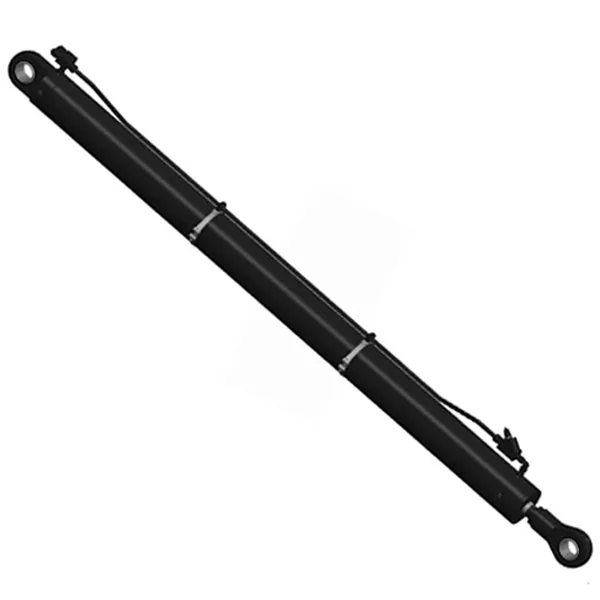
Stroke length is the distance that the cylinder rod travels from the fully retracted position to the fully extended position. For a Telescopic Hydraulic Cylinder, the total stroke is the sum of the strokes of each individual stage. A two-stage cylinder might have a total stroke of 800 mm, with each stage contributing 400 mm. A three-stage cylinder might have a total stroke of 1,200 mm, with each stage contributing 400 mm. The stroke length is the primary parameter that determines the size and configuration of the cylinder. It affects the number of stages, the closed length, the weight, and the cost. The table below illustrates the relationship between stroke length and the number of stages for a typical telescopic cylinder.
| Total Stroke (mm) | Number of Stages | Stroke per Stage (mm) | Typical Application |
| 300 - 600 | 2 | 150 - 300 | Small dump trailers, lifts |
| 600 - 1,200 | 3 | 200 - 400 | Dump trucks, refuse compactors |
| 1,200 - 2,000 | 4 | 300 - 500 | Large dump trucks, mining equipment |
| 2,000 - 3,000 | 5 | 400 - 600 | Aerial work platforms, heavy lifting |
At Raydafon Technology Group Co.,Limited, our factory manufactures Telescopic Hydraulic Cylinders with stroke lengths ranging from 300 mm to 3,000 mm. We can customize the stroke length and the number of stages to meet your specific application requirements. Our engineering team can help you determine the optimal stroke length and stage configuration for your project.
The number of stages in a Telescopic Hydraulic Cylinder is determined by the total stroke length and the maximum allowable stroke per stage. Each stage has a maximum stroke that is limited by the length of the stage and the overlap required for stability. A typical stage can extend to about 80-90% of its length. If the total stroke requires more than one stage can provide, additional stages are added. The number of stages affects the complexity, cost, and performance of the cylinder. More stages mean more components, more seals, and more potential leak points. However, more stages also mean a shorter closed length for a given stroke. The table below shows the relationship between total stroke, stage stroke, and number of stages.
| Total Stroke (mm) | Max Stroke per Stage (mm) | Minimum Number of Stages | Closed Length (approx.) |
| 600 | 400 | 2 | 350 mm |
| 1,200 | 400 | 3 | 500 mm |
| 2,000 | 500 | 4 | 650 mm |
| 3,000 | 600 | 5 | 800 mm |
At our factory, we design each Telescopic Hydraulic Cylinder to optimize the number of stages for the required stroke. We use advanced calculation software to determine the optimal stage lengths and overlaps. Our goal is to provide a cylinder that fits the available space, provides the required stroke, and performs reliably under load.
The closed length of a Telescopic Hydraulic Cylinder is the length of the cylinder when all stages are fully retracted. The closed length is critical for installation because it determines whether the cylinder will fit in the available space. A longer stroke requires a longer cylinder, but the relationship is not linear. A telescopic cylinder can achieve a long stroke with a relatively short closed length because the stages nest inside each other. The ratio of closed length to stroke is a key performance metric. A single-stage cylinder typically has a closed length that is about 1.2 to 1.5 times the stroke. A two-stage telescopic cylinder might have a closed length that is 0.8 to 1.0 times the stroke. A three-stage cylinder might have a closed length that is 0.5 to 0.7 times the stroke. The table below compares the closed length ratios for different cylinder types.
| Cylinder Type | Closed Length / Stroke Ratio | Installation Space Required |
| Single-Stage | 1.2 - 1.5 | Large |
| Two-Stage Telescopic | 0.8 - 1.0 | Moderate |
| Three-Stage Telescopic | 0.5 - 0.7 | Compact |
| Four-Stage Telescopic | 0.4 - 0.6 | Very Compact |
| Five-Stage Telescopic | 0.3 - 0.5 | Ultra Compact |
At Raydafon, our factory designs Telescopic Hydraulic Cylinders to achieve the shortest possible closed length for a given stroke. We use high-strength materials and precision manufacturing to minimize the wall thickness of each stage while maintaining the required pressure rating. This allows us to pack more stroke into a smaller package, making our cylinders ideal for applications where installation space is limited.
Buckling is a critical consideration for Telescopic Hydraulic Cylinders, especially for long strokes. As the cylinder extends, the effective length of the rod increases, and the buckling resistance decreases. A telescopic cylinder is more susceptible to buckling than a single-stage cylinder because the stages are slender and the load is transmitted through multiple sliding interfaces. The buckling resistance depends on the diameter of each stage, the overlap between stages, and the guidance provided by the cylinder body. For a given stroke, a cylinder with more stages will have a smaller diameter for each stage, which reduces buckling resistance. Therefore, the stroke length and the number of stages must be balanced against the required buckling safety factor. The table below illustrates the effect of stroke length on buckling resistance for a typical three-stage cylinder.
| Stage | Diameter (mm) | Stroke (mm) | Critical Buckling Load (kN) |
| Stage 1 (Base) | 120 | 400 | 450 |
| Stage 2 | 100 | 400 | 280 |
| Stage 3 (Top) | 80 | 400 | 150 |
At our factory, we use advanced computer-aided engineering (CAE) software to perform buckling analysis on every Telescopic Hydraulic Cylinder we design. We optimize the diameter and overlap of each stage to ensure that the cylinder can withstand the required load without buckling. We also provide guidance on the maximum allowable stroke for each cylinder model.
Specifying the right stroke length for a Telescopic Hydraulic Cylinder requires a systematic evaluation of your application requirements. The first step is to determine the required travel distance. This is the distance that the load must move. The second step is to determine the available installation space. This is the space available for the cylinder when it is fully retracted. The third step is to determine the required force. This is the load that the cylinder must move. The fourth step is to determine the required buckling safety factor. This is the margin of safety against buckling. The fifth step is to select the cylinder configuration that meets these requirements. The table below provides a guide to stroke length selection for common applications.
| Application | Typical Stroke (mm) | Number of Stages | Key Consideration |
| Dump Truck | 800 - 1,500 | 3 - 4 | Closed length must fit under bed |
| Refuse Compactor | 600 - 1,200 | 2 - 3 | High cycle life, contamination resistance |
| Aerial Work Platform | 1,500 - 3,000 | 4 - 5 | Buckling resistance, stability |
| Hydraulic Press | 300 - 800 | 2 | High force, precision guidance |
| Mining Equipment | 1,000 - 2,500 | 3 - 5 | Durability, shock resistance |
At Raydafon, our factory works with our customers to specify the right stroke length and cylinder configuration for their application. We provide technical data, calculations, and recommendations. Our engineering team can assist with the selection process and provide detailed drawings for approval.
The following table provides the key product parameters for our Telescopic Hydraulic Cylinders. These cylinders are designed for a wide range of applications, including dump trucks, refuse compactors, aerial work platforms, and hydraulic presses. Our factory can also produce custom cylinders to meet specific requirements.
| Parameter | Specification Range | Notes |
| Total Stroke | 300 - 3,000 mm | Custom strokes available |
| Number of Stages | 2 - 5 | Selected based on stroke and space |
| Bore Diameter | 50 - 250 mm | Selected based on force |
| Rod Diameter | 30 - 180 mm | Selected based on buckling |
| Operating Pressure | Up to 350 bar | Higher pressures available |
| Mounting Type | Clevis, Trunnion, Flange, Threaded | Selected based on application |
| Seal Material | Polyurethane, PTFE, NBR | Selected for temperature and fluid |
| Rod Coating | Hard Chrome, Ceramic | Selected for wear resistance |
| Barrel Material | ST52, E355, 27SiMn | Seamless steel tube |
| Operating Temperature | -30°C to +100°C | High-temperature options available |
| MOQ | 10 pieces | Negotiable for large orders |
| Lead Time | 4 - 8 weeks | Depends on complexity and quantity |
At our factory, we manufacture our Telescopic Hydraulic Cylinders to meet these specifications and more. We can customize the stroke, number of stages, bore, rod, mounting, and seals to suit your specific application. Our quality control system includes inspection of raw materials, in-process inspection, and final inspection before shipment. Our goal is to provide our customers with high-quality Telescopic Hydraulic Cylinders that meet their performance requirements.
Question 1: How do I determine the required stroke length for my application?
Answer: The required stroke length is the distance that the load must travel. This is determined by the geometry of the mechanism. For a dump truck, the stroke is the distance required to raise the bed to the desired angle. For an aerial work platform, the stroke is the distance required to raise the platform to the desired height. Our engineering team can help you calculate the required stroke for your specific application.
Question 2: Can a telescopic cylinder have a longer stroke than a single-stage cylinder?
Answer: Yes, a Telescopic Hydraulic Cylinder can achieve a much longer stroke than a single-stage cylinder of the same closed length. This is because the stages nest inside each other when retracted. A three-stage telescopic cylinder can achieve a stroke that is 2-3 times the stroke of a single-stage cylinder with the same closed length. This makes telescopic cylinders ideal for applications where installation space is limited.
Question 3: What is the maximum number of stages available?
Answer: At Raydafon Technology Group Co.,Limited, we manufacture Telescopic Hydraulic Cylinders with up to five stages. The maximum number of stages is determined by the required stroke, the available installation space, and the buckling requirements. More stages allow a longer stroke in a shorter closed length, but they also increase complexity and cost.
Question 4: How does stroke length affect the cost of a telescopic cylinder?
Answer: The cost of a Telescopic Hydraulic Cylinder increases with stroke length and the number of stages. A longer stroke requires more material and more precise manufacturing. More stages require more seals, more machining, and more assembly time. The cost also depends on the pressure rating, the materials, and the mounting configuration. Our factory can provide a detailed quote based on your specific requirements.
Question 5: Can the stroke length be customized?
Answer: Yes, we can customize the stroke length to meet your specific application requirements. We can adjust the length of each stage and the number of stages to achieve the desired total stroke. We can also customize the closed length, the bore, the rod, and the mounting. Our engineering team can work with you to design a Telescopic Hydraulic Cylinder that fits your application perfectly.
Stroke length is the most important parameter in the selection of Telescopic Hydraulic Cylinders. It determines the number of stages, the closed length, the buckling resistance, and the overall performance of the cylinder. For buyers, understanding the relationship between stroke length and these factors is essential for specifying the right cylinder for their application. At Raydafon Technology Group Co.,Limited, our factory has the expertise and the equipment to manufacture high-quality Telescopic Hydraulic Cylinders with stroke lengths ranging from 300 mm to 3,000 mm. We use high-strength materials, precision manufacturing, and rigorous testing to ensure that our cylinders deliver reliable performance and long service life.
Whether you are designing a dump truck, a refuse compactor, an aerial work platform, or a hydraulic press, we invite you to contact us to discuss your requirements. We can provide technical data, samples, and customized solutions. Our commitment to quality and customer satisfaction has made us a trusted partner for businesses around the world.
Contact Raydafon Technology Group Co.,Limited today to discuss your Telescopic Hydraulic Cylinder requirements and discover how our cylinders can meet your stroke length and performance needs.
+86-574-87168065
Luotuo Industrial Area, Zhenhai District, Ningbo City, China