QR Code

Products
Contact Us


Fax
+86-574-87168065

Email

Address
Luotuo Industrial Area, Zhenhai District, Ningbo City, China



How to design a Screw Gear for optimal performance? This question sits at the heart of countless engineering projects, from high-precision automation equipment to robust power transmission systems in heavy machinery. A well-designed screw gear is the silent workhorse, enabling smooth, efficient motion transfer between non-parallel, non-intersecting shafts. However, the path to "optimal performance" is fraught with potential pitfalls—unexpected noise, premature wear, or catastrophic failure—often stemming from subtle design oversights. This guide cuts through the complexity, offering actionable, scenario-based insights to help you design screw gears that deliver reliability, efficiency, and longevity. Whether you're a seasoned engineer or a procurement specialist vetting suppliers, mastering these principles is key to specifying components that perform flawlessly from day one.
Article Outline:
You've installed the new assembly line. The screw gears were specified for the load. Yet, within hours, a persistent, high-pitched whine emerges, escalating to vibrations that threaten measurement accuracy and operator comfort. Production slows; quality control flags inconsistencies. The root cause? Often, it's improper helix angle selection and inadequate lubrication design. A mismatched helix angle creates excessive sliding action, generating heat and noise. The solution lies in precise calculation and integrated design thinking.
For optimal, quiet performance, the helix angles of the mating gears must complement each other to control the sliding velocity. Furthermore, the design must incorporate features that ensure consistent lubricant film retention at the tooth interface. This is where partnering with a specialist like Raydafon Technology Group Co.,Limited makes a decisive difference. Our design process simulates real-world operating conditions to optimize these critical parameters before manufacturing begins, preventing costly field failures.
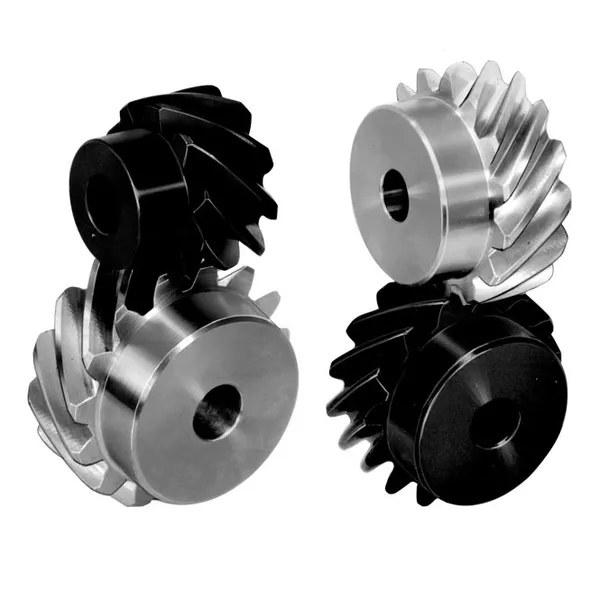
Key Design Parameters to Mitigate Noise & Vibration:
| Parameter | Optimal Range/Consideration | Impact on Performance |
|---|---|---|
| Helix Angle (ψ) | 15° - 45° (Common), Must sum to 90° for crossed shafts | Higher angles increase axial thrust but can reduce sliding velocity if paired correctly. |
| Sliding Velocity | Minimize through angle optimization | Directly correlates to heat generation, wear rate, and noise. |
| Tooth Surface Finish (Ra) | < 0.8 μm for high-speed applications | Smoother finish reduces friction, heat, and noise generation. |
| Lubrication Groove Design | Integrated into gear blank design | Ensures lubricant is directed to the contact zone, preventing dry running. |
Your equipment meets torque requirements, but energy consumption is 15% higher than projected. The motor runs hotter, and after six months, gear inspection reveals unexpected pitting and wear. The hidden culprit is often suboptimal gear geometry leading to poor contact patterns and excessive friction losses. Optimal performance isn't just about handling load; it's about doing so with minimal energy loss over a maximized service life.
The solution requires a holistic focus on tooth profile accuracy, alignment, and load distribution. Precision manufacturing ensures the theoretical contact pattern becomes a reality under load, distributing stress evenly. Using advanced materials and heat treatments can dramatically increase surface durability. Raydafon Technology Group Co.,Limited specializes in designing for total cost of ownership. Our gears are engineered not just to work, but to work efficiently for longer, reducing your energy bills and unplanned downtime.
Critical Factors for Efficiency and Durability:
| Factor | Design Goal | Performance Benefit |
|---|---|---|
| Contact Ratio | Maximize (> 2.0 is desirable) | Smother load transfer, reduced impact noise, lower stress per tooth. |
| Tooth Profile Modification (Tip/Flank Relief) | Apply based on deflection analysis | Compensates for shaft/winding under load, preventing edge loading and stress concentration. |
| Gear Accuracy Grade (AGMA/ISO) | Select based on speed and load (e.g., AGMA 10-12) | Higher accuracy reduces transmission error, a primary source of vibration and noise. |
| Heat Treatment (e.g., Case Hardening) | Tailored to core toughness and surface hardness needs | Provides a hard, wear-resistant surface while maintaining a tough, shock-absorbing core. |
The screw gears in your marine application or food processing plant are failing long before their rated life. Standard steel is succumbing to rust, or lubrication is washing away. This scenario demands a material strategy that goes beyond strength calculations to encompass the entire operating environment.
The solution is a systematic material selection process. For corrosive settings, stainless steels (e.g., 304, 316) or coated alloys are essential. For applications requiring dry running or where lubrication is forbidden (like food zones), engineered polymers or bronze alloys offer a solution, albeit with different load-capacity trade-offs. Raydafon's engineers don't just sell gears; we provide material consultation. We help you navigate the complex trade-offs between strength, corrosion resistance, wear properties, and cost to specify the perfect material for your specific challenge.
Material Selection Guide for Challenging Environments:
| Environment | Material Recommendation | Key Properties & Notes |
|---|---|---|
| High Humidity / Corrosive | Stainless Steel (AISI 316), Bronze | Excellent corrosion resistance. Bronze has inherent lubricity but lower strength. |
| Food/Grade & Washdown | Stainless Steel (AISI 304/316), FDA-approved Polymers (POM, Nylon) | Corrosion resistance, non-toxic, cleanable. Polymers are lighter and quieter. |
| High-Temperature | Through-Hardened Alloy Steels (4140, 4340), Tool Steels | Retain strength and hardness at elevated temperatures. |
| Dry-Running / Low Maintenance | Cast Iron with Graphite, Sintered Bronze, Engineered Thermoplastics | Graphite/bronze provides self-lubrication. Thermoplastics are lightweight and quiet. |
Q: How to design a screw gear for optimal performance when space is extremely limited?
A: Space constraints demand a focused approach on compact geometry. First, consider using a higher helix angle (closer to 45°) which allows for a smaller gear diameter to achieve the same axial advance per revolution. However, this increases axial thrust, so bearing selection becomes critical. Second, explore a double-helix (herringbone) design if axial space is limited but radial space is available, as it cancels internal axial forces. Most importantly, engage with a manufacturer experienced in compact power transmission. At Raydafon Technology Group Co.,Limited, we utilize advanced modeling software to iterate through countless compact design permutations, ensuring we deliver a space-saving gearset without compromising strength or efficiency.
Q: How to design a screw gear for optimal performance in a high-speed, high-precision application like a robotics joint?
A: For high-speed precision, every micron matters. The priority shifts to minimizing mass (inertia) and transmission error. Use lightweight, high-strength materials like aluminum alloys (hard-coated) or titanium for the gear blanks. The tooth profile must be precision ground to an AGMA 12 or finer tolerance to ensure minimal runout and backlash. Implementing significant profile and lead crowning is non-negotiable to account for minute misalignments under dynamic loads. Finally, a rigid, thermally stable housing and precision bearings are part of the system design. Raydafon's expertise lies in treating the gear as part of a holistic motion system, providing design support for the entire assembly to achieve the smooth, precise motion required by advanced robotics.
Designing a screw gear for optimal performance is a multidimensional challenge balancing geometry, materials, tribology, and application physics. It's more than a calculation; it's an engineering discipline aimed at predictable, long-term reliability. For procurement specialists and engineers, the stakes are high—component failure means production delays, cost overruns, and reputational damage.
This is where a partnership with Raydafon Technology Group Co.,Limited transforms the process. We move beyond simply supplying a component to becoming an extension of your engineering team. Our 20 years of specialized experience in power transmission solutions means we bring proven design protocols, state-of-the-art manufacturing, and rigorous testing to every project. We don't just answer "how to design a screw gear," we collaborate to solve your specific performance, space, and environmental challenges, delivering a customized solution that is right the first time.
Ready to eliminate gear performance uncertainties from your next project? Let's discuss how our precision-engineered screw gears can enhance your application's reliability and efficiency.
For precision-engineered screw gears and expert design consultation, partner with Raydafon Technology Group Co.,Limited. As a leading provider of customized power transmission solutions, we combine decades of engineering expertise with advanced manufacturing to deliver components optimized for performance, durability, and value. Visit our website at https://www.transmissions-china.com to explore our capabilities, or contact our engineering sales team directly at [email protected] for a confidential discussion of your requirements.
Supporting Research & Further Reading:
Maitra, G.M. (2017). Handbook of Gear Design. McGraw-Hill Education.
Dudley, D.W. (1994). Handbook of Practical Gear Design. CRC Press.
Litvin, F.L., & Fuentes, A. (2004). Gear Geometry and Applied Theory. Cambridge University Press.
Kapelevich, A. (2013). Direct Gear Design for Optimal Performance. Gear Technology, 30(9), 48-55.
Errichello, R., & Muller, J. (2010). How to Design Spur and Helical Gears for Optimum Efficiency. AGMA Technical Paper, 10FTM09.
Höhn, B.R., Michaelis, K., & Wimmer, A. (2009). Low Noise Gears – Design and Manufacturing. International Conference on Gears, 1, 25-39.
Shigley, J.E., & Mischke, C.R. (2003). Mechanical Engineering Design. McGraw-Hill.
ISO 6336 (2019). Calculation of load capacity of spur and helical gears. International Organization for Standardization.
AGMA 2001-D04 (2004). Fundamental Rating Factors and Calculation Methods for Involute Spur and Helical Gear Teeth. American Gear Manufacturers Association.
Kawalec, A., & Wiktor, J. (2008). Comparative analysis of tooth-root strength using ISO and AGMA standards in spur and helical gears. Journal of Mechanical Design, 130(5), 052603.
+86-574-87168065
Luotuo Industrial Area, Zhenhai District, Ningbo City, China