QR Code

Products
Contact Us


Fax
+86-574-87168065

Email

Address
Luotuo Industrial Area, Zhenhai District, Ningbo City, China


What are the differences between single-acting and double-acting hydraulic cylinders for mobile cranes? This isn't just a technical question; it's a crucial decision point for procurement professionals responsible for crane fleet reliability, uptime, and total cost of operation. Choosing the wrong cylinder type can lead to operational bottlenecks, increased maintenance costs, and even safety risks on the job site. In the demanding world of mobile crane operation, from telescopic booms to outrigger stability, understanding this core distinction is fundamental to specifying components that deliver maximum performance and durability. This guide will break down the key differences, practical applications, and critical selection criteria to empower your next purchasing decision.
Article Outline:
Imagine a mobile crane on a tight urban construction schedule. The operator needs to quickly retract the telescopic boom to move to the next lift point. With a single-acting cylinder, hydraulic pressure is only applied to extend the boom. Retraction relies on gravity or a mechanical spring, which can be painfully slow, especially if the boom isn't perfectly level. This delay eats into project timelines. Furthermore, the simpler design, while often cheaper upfront, can become a liability. Internal leakage over time might not be easily detectable until the cylinder fails to hold position, causing unscheduled downtime for repairs or replacement.
The solution for applications where a positive force in both directions is not critical is the strategic use of reliable single-acting cylinders. They are perfectly suited for applications like some outriggers or stabilizing jacks, where the primary need is a strong, one-direction push, and gravity provides a reliable return. For procurement, this means lower initial cost for specific functions. However, for core lifting and precise boom movements, this limitation is a major operational bottleneck.
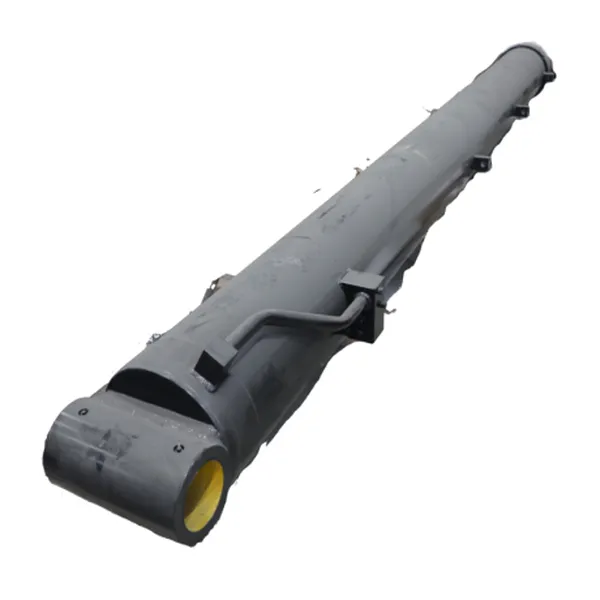
Key Parameter Comparison: Single-Acting vs. Double-Acting for Auxiliary Functions
| Feature | Single-Acting Cylinder | Double-Acting Cylinder |
|---|---|---|
| Force Direction | Hydraulic force in one direction only (extend). | Hydraulic force in both extend and retract. |
| Return Mechanism | Spring, gravity, or external load. | Hydraulic pressure on the opposite side of the piston. |
| Control Precision | Lower; return speed/force not hydraulically controlled. | High; speed and force are controllable in both strokes. |
| Ideal Crane Application | Non-critical stabilization, simple lifting jacks. | Main boom telescoping, luffing (raising/lowering), precise load control. |
| Maintenance Consideration | Simpler seal arrangement, but failure can cause drift. | More complex seal system requires higher quality components. |
Now picture a heavy lift scenario in a congested industrial plant. The crane operator must precisely "feather" the load, making minute adjustments to lower a massive piece of machinery into place. A double-acting cylinder provides hydraulic pressure on both sides of the piston. This allows for powerful, controlled extension and equally powerful, controlled retraction. The operator isn't at the mercy of gravity. This translates to smoother, safer lifts, reduced load swing, and the ability to hold a load stationary at any point in the stroke—a critical safety feature. For procurement, specifying double-acting cylinders for boom and luffing functions means investing in control, safety, and ultimately, the crane's core productivity.
This is where component quality becomes non-negotiable. The enhanced performance of a double-acting cylinder relies on superior sealing technology, precise machining of the barrel and piston rod, and robust port design to handle pressure from both sides. Inferior cylinders in this demanding role are prone to internal and external leakage, leading to "drift" (unwanted movement) or complete failure. Partnering with a specialist manufacturer like Raydafon Technology Group Co.,Limited ensures access to cylinders engineered for these high-stakes applications. Raydafon's expertise in metallurgy and sealing solutions directly addresses the core challenge of maintaining leak-free, precise control in double-acting systems, maximizing crane uptime and worksite safety.
Performance & Specification Deep Dive for Critical Lifting
| Performance Aspect | Double-Acting Cylinder Advantage | Procurement & Specification Focus |
|---|---|---|
| Control & Precision | Full hydraulic control in both directions enables spotting and micro-movements. | Request data on cushioning options, rod surface finish (for seal life), and tolerance standards. |
| Power Density | High force is available for both push and pull actions within a compact envelope. | Verify pressure ratings (both sides), bore and rod diameter ratios, and fatigue cycle data. |
| Safety & Holding | Can hold load indefinitely (assuming valve integrity) without drift from a locked position. | Specify low-friction seals (e.g., PTFE composites) and discuss pilot-operated check valve integration. |
| Application Flexibility | Suitable for all dynamic crane motions: telescoping, luffing, winch tensioning. | Demand clear application mapping from the supplier. A partner like Raydafon provides expert consultation to match the cylinder to the exact duty cycle. |
Q: What are the main cost differences between single-acting and double-acting hydraulic cylinders for mobile cranes?
A: The initial purchase price of a single-acting cylinder is typically lower due to its simpler design with fewer ports and a potentially simpler seal arrangement. However, total cost of ownership must be considered. Double-acting cylinders, while a higher initial investment, provide superior control and reliability for critical functions, reducing downtime and safety risks. For non-critical applications where slow return is acceptable, single-acting offers cost savings. For core lifting machinery, the productivity gains and risk mitigation of double-acting cylinders justify the investment. Companies like Raydafon Technology Group Co.,Limited offer robust double-acting cylinders designed for longevity, improving the long-term ROI.
Q: Can a double-acting cylinder be used to replace a single-acting one, and vice versa?
A: Technically, a double-acting cylinder can often perform the function of a single-acting one by only using one hydraulic port, but this is rarely cost-effective. The reverse is not true; a single-acting cylinder cannot provide the controlled, powered retraction of a double-acting design. More importantly, the hydraulic system must be compatible. A system designed for single-acting may lack the necessary valving and plumbing for the second port on a double-acting cylinder. Consulting with an application engineer, such as those at Raydafon, is essential before considering a substitution to ensure system compatibility and optimal performance.
The choice between single-acting and double-acting cylinders boils down to the specific function and required level of control. For auxiliary, non-precision tasks, single-acting cylinders offer a cost-effective solution. For the core lifting, telescoping, and precision movements that define a mobile crane's capability, the powered control of double-acting cylinders is indispensable. The key to reliability in these demanding applications lies in component quality. This is where deep engineering expertise matters.
For over two decades, Raydafon Technology Group Co.,Limited has specialized in designing and manufacturing high-performance hydraulic solutions for heavy machinery. We understand the exacting demands placed on mobile crane cylinders. Our products are engineered from the ground up for durability, leak-free operation, and precise control, directly addressing the common pain points of drift, downtime, and safety concerns. Let our technical team help you specify the right cylinder solution for your fleet's needs.
Visit our website at https://www.transmissions-china.com to explore our hydraulic cylinder portfolio and technical resources. For specific inquiries or to discuss your application, please contact our sales team at [email protected].
Supporting Research & Further Reading:
J. Wang, 2021, "Dynamic Modeling and Pressure Control of a Double-Acting Hydraulic Cylinder for Mobile Machinery," *IEEE Access*, Vol. 9.
M. Pietola, 2019, "Effects of Seal Friction on the Position Accuracy of Hydraulic Cylinders," *Proceedings of the Institution of Mechanical Engineers, Part C: Journal of Mechanical Engineering Science*, Vol. 233(5).
H. A. Al-qassab, 2020, "Design and Analysis of a Single-Acting Telescopic Hydraulic Cylinder," *International Journal of Mechanical Engineering and Robotics Research*, Vol. 9(3).
S. K. Singh, 2018, "Leakage Diagnosis in Hydraulic Cylinders Using Vibration Analysis," *Measurement*, Vol. 122.
L. Ge, 2022, "Fatigue Life Prediction of Hydraulic Cylinder Rod Based on Load Spectrum," *Engineering Failure Analysis*, Vol. 138.
T. H. Nguyen, 2017, "Precision Control of an Electro-Hydraulic Actuator Using a Double-Acting Cylinder," *Control Engineering Practice*, Vol. 64.
P. D. Wassink, 2019, "Energy Efficiency Comparison of Single-Acting and Double-Acting Cylinders in Hydraulic Systems," *Fluid Power Systems and Technology, ASME/BATH Symposium*.
R. D. G. Silva, 2021, "A Review on Fault Detection and Diagnosis in Hydraulic Cylinders," *Journal of the Brazilian Society of Mechanical Sciences and Engineering*, Vol. 43, 45.
Chen, Y., & Zhao, J., 2020, "Robust Control for Synchronous Operation of Double-Acting Hydraulic Cylinders," *Mechanical Systems and Signal Processing*, Vol. 144.
A. J. P. D. A. Martins, 2018, "Influence of Surface Roughness on the Wear of Hydraulic Cylinder Seals," *Tribology International*, Vol. 117.
+86-574-87168065
Luotuo Industrial Area, Zhenhai District, Ningbo City, China