QR Code

Products
Contact Us


Fax
+86-574-87168065

Email

Address
Luotuo Industrial Area, Zhenhai District, Ningbo City, China



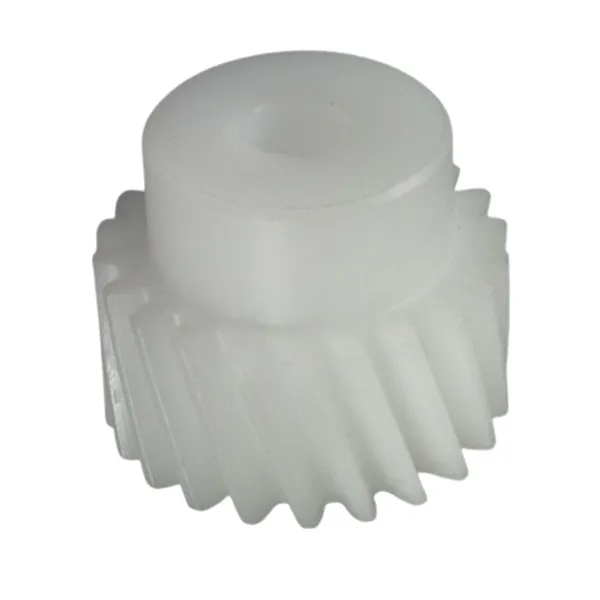

Injection-moulded helical gears for small drives that need quiet running, no lubrication and low weight. Standard tooling covers modules M0.1–M2.0, bores from Ø1.40 to Ø3.05 mm, outer diameters Ø10–Ø50 mm and face widths 2.0–10.0 mm, with moulded tooth geometry instead of cut teeth — so tooth-to-tooth consistency holds across the batch.
Raydafon moulds plastic helical gears in its own factory in Ningbo, China, for OEMs that need a quiet, self-lubricating gear rather than a cut steel one. The gear teeth are formed in the injection mould, so the helix angle, profile and bore position are fixed by the tool rather than by a later machining step — which is why batch-to-batch tooth form stays consistent and why unit cost drops once the tool is running. Typical buyers are small-machinery builders, medical and laboratory equipment makers, appliance and pump manufacturers, and anyone replacing a lubricated metal gear pair with a maintenance-free plastic one.
Standard tooling is the fastest and cheapest route: send the module, tooth count, helix angle, bore and face width, and if the mould exists we quote from stock tooling. Where the geometry is new, we build the tool and mould to your drawing. Related products from the same workshop include the helical gear range in metal for higher torque, the full plastic gear line in spur, worm and internal forms, and spur gears if your drive does not need helical overlap.
Standard specification. Bore, outer diameter and face width are flexible within the ranges shown — tell us the values you need.
| Type | Module | Material | Bore | Outer diameter | Face width (L) |
|---|---|---|---|---|---|
| Helical gear | M0.1 – M2.0 | Polyacetal (POM) / Nylon | Ø1.40 / Ø1.90 / Ø2.05 / Ø2.40 / Ø2.55 / Ø2.90 / Ø3.05 mm (flexible) | Ø10.0 – Ø50.0 mm (flexible) | 2.0 – 10.0 mm (flexible) |
Tolerance and capacity: moulded plastic gears hold a wider tolerance band than cut metal gears, and the exact figures depend on module, wall thickness and material grade. Please state the backlash and centre-distance tolerance your assembly needs at the quotation stage — we will confirm what the tooling can hold, or recommend a cut gear if plastic cannot meet it.
The default choice for small precision gears. Low friction, high stiffness and very stable dimensions under moisture, which keeps centre distance and backlash predictable. Best for continuous-running drives and for assemblies where the gear must hold tolerance over months.
Tougher and more impact tolerant than POM, with better damping of shock and vibration, but it absorbs moisture and changes dimension slightly with humidity. Suited to intermittent, impact-loaded or high-vibration drives rather than tight-tolerance positioning.
Adding glass fibre raises strength and stiffness for higher torque, and improves creep resistance at elevated temperature, but increases mould wear and reduces the natural damping slightly. We will advise on grade and expected life for your duty.
If your torque requirement is beyond what moulded plastic can carry, the honest answer is a cut gear — see our spur gear and helical gear range in metal. We would rather quote the right part than sell a plastic gear that fails in service.
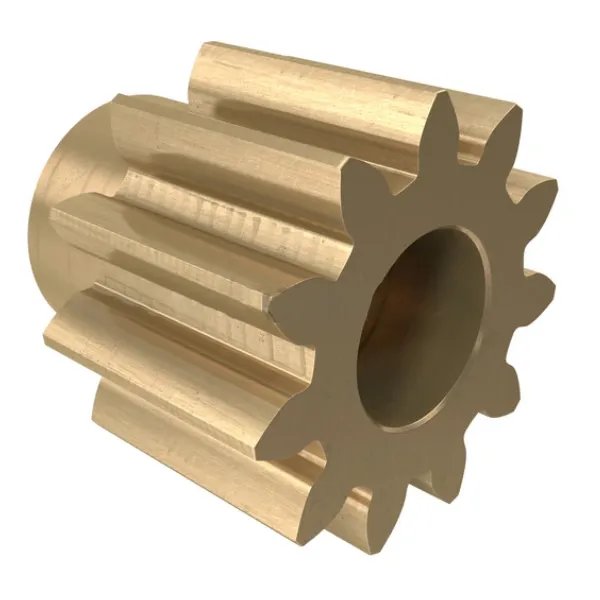
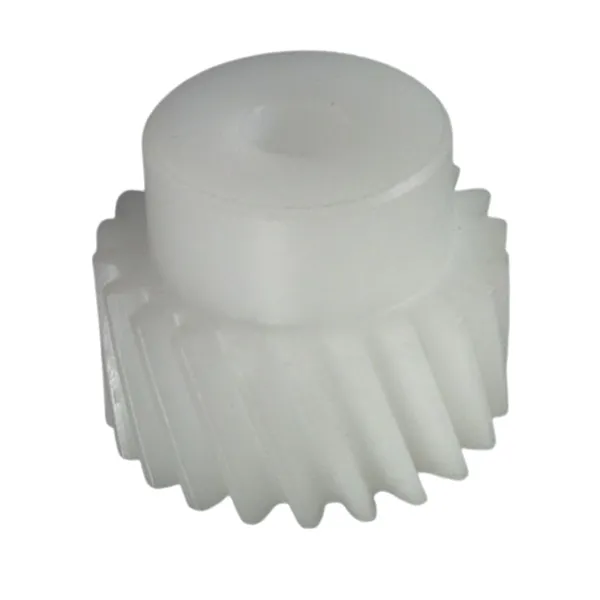
The photographs below show our moulded plastic helical gears: tooth form, hub and bore finish, and the assembled gear set.

POM and nylon run against each other or against steel without an oil or grease film, so a gearbox that previously needed a lubricant chamber, seals and a service interval can be built maintenance-free.
The helix overlap of a helical tooth engages gradually rather than with a single impact, and the polymer itself damps vibration — measured noise on our gears is about 20% below equivalent spur-gear drives in the same application.
Moulded plastic is far lighter than steel or brass, which cuts the inertia of the driven parts. That matters in hand tools, portable instruments, small positioning mechanisms and other weight-sensitive products.
Engineering plastics do not rust and resist most acids, alkalis, detergents and food-contact cleaning agents, so the gear can run in humid, washed-down or mildly corrosive environments where a metal gear would need plating.
Tooth form comes from the mould cavity, so every part in the batch is essentially identical — no cutter wear drift, no run-to-run profile variation, and much less inspection effort for you.
Tool, moulding and inspection all happen under one roof, with no trading margin in between. Unit price is driven by the tooling stage, not by a middle layer.
A spur gear's teeth meet the mating teeth all at once. A helical gear's teeth are set at an angle to the axis, so contact begins at one end of the tooth and sweeps across to the other, the way a zip closes. Load therefore builds up gradually instead of arriving as an impact, which is the main reason a helical pair runs smoother and quieter than a spur pair at the same speed and load.
The second effect is load sharing. Because several teeth are in contact at any moment along that diagonal line, the force needed to transmit a given torque is spread over a larger area of tooth flank, so local contact pressure is lower and surface wear is slower. A single plastic tooth carrying the whole load would deform; a set of teeth sharing it does not — which is exactly why helical geometry suits relatively soft materials such as POM and nylon.
Helical teeth also produce an axial thrust load along the shaft, so the bearings or thrust washers on the shaft must be able to take it. That is the one design point worth checking before specifying a helical gear in place of a spur gear: the tooth overlap buys quietness and load sharing, but it hands an extra axial force to the rest of the assembly.
If your application is not listed, send the drawing or the sample part. In most cases we can confirm from the module, bore and helix angle whether standard tooling fits or a new mould is needed.
Send your drawing or sample details — module, tooth count, helix angle, bore, face width, material and quantity. We confirm whether standard tooling fits or a new mould is required, and reply with price and lead time within 24 hours.
Send Inquiry Now* Figures quoted (noise reduction, temperature range, module and bore ranges) refer to standard tooling and normal duty conditions. Please confirm the final drawing and material grade before ordering.
Address
Luotuo Industrial Area, Zhenhai District, Ningbo City, China
Tel
+86-574-87168065
Luotuo Industrial Area, Zhenhai District, Ningbo City, China